10 Essential Tips for Choosing the Right Laminating Adhesive
Choosing the right laminating adhesive is crucial for both durability and quality. John Smith, a leading expert in the laminating industry, once said, "The right adhesive can make or break your project." His insight highlights the importance of selecting the suitable product for your needs.
Many factors can influence your choice of laminating adhesive. For instance, the substrate material plays a significant role. Not all adhesives work well with every surface. Additionally, you must consider the environmental conditions, such as humidity and temperature. These factors can affect adhesion strength.
Often, people overlook the specifics. They might choose an adhesive based solely on cost or brand reputation. This approach can lead to problems later on. A poor choice may result in peeling or yellowing over time. Understanding your project's requirements is essential. Only then can you find an adhesive that meets your expectations.
Understanding Different Types of Laminating Adhesives
When selecting a laminating adhesive, understanding the different types is crucial. There are several options available, each suited for specific projects. Cold adhesives are user-friendly and ideal for photos. They require no heat for application, making them perfect for delicate materials. Hot laminating adhesives create a strong bond but need heat to activate. This option tends to be more durable.
Choosing an adhesive can be tricky. Consider the materials you’re working with. Some adhesives may not work well with certain papers or plastics.
Testing a small sample can save you time and resources. Remember, not all adhesives are created equal. Some may leave a residue or bubble, which can affect the final look.
Be mindful of the adhesive thickness. A thicker adhesive can offer more protection, but it might alter the piece's appearance. This factor often leads to disappointment when the final product doesn’t meet expectations. Take your time to evaluate options. Sometimes, the quickest choice isn’t the best.
Assessing the Compatibility with Your Materials
When selecting a laminating adhesive, compatibility with your materials is crucial. The right adhesive ensures a strong bond and prevents issues like bubbling or peeling. According to a report from the Adhesive and Sealant Council, improper adhesive selection can lead to a 35% increase in project failures. This statistic highlights how important it is to assess materials thoroughly.
Consider the surfaces you’re laminating. For instance, porous materials like paper require different adhesives than non-porous surfaces like plastic. A study revealed that using a solvent-based adhesive on porous materials can lead to inadequate bonding. This often results in premature product failure. Pay attention to the chemical properties of both your adhesive and your materials. Ensure they can intertwine effectively.
Testing is vital. It’s not enough to rely solely on compatibility claims. Perform bond tests to verify effectiveness. A small test sample helps identify potential issues. Adhesives can behave differently than expected, even if similar materials seem compatible. Always be prepared for adjustments or alternative solutions based on the results you obtain. Balancing all these factors can feel challenging but is essential for achieving the best outcome.
10 Essential Tips for Choosing the Right Laminating Adhesive - Assessing the Compatibility with Your Materials
| Tip Number |
Tip Description |
Material Compatibility |
Recommended Adhesive Types |
| 1 |
Identify your material type |
Paper, Plastic |
Polypropylene, Polyethylene adhesive |
| 2 |
Consider the finish you want |
Glossy, Matte |
Acrylic, EVA adhesive |
| 3 |
Assess environmental factors |
Indoor, Outdoor |
UV-resistant adhesive |
| 4 |
Evaluate temperature range |
High-Temperature, Low-Temperature |
Thermal adhesive |
| 5 |
Look for chemical resistance |
Solvents, Oils |
Chemical-resistant adhesive |
| 6 |
Consider curing time |
Fast, Slow |
Quick-drying adhesive |
| 7 |
Check for compatibility with laminating machines |
Specific equipment |
Machine-grade adhesive |
| 8 |
Research bonding strength needed |
Light-duty, Heavy-duty |
High-bond adhesive |
| 9 |
Account for moisture exposure |
High humidity areas |
Waterproof adhesive |
| 10 |
Seek expert recommendations |
Various materials |
Custom formulations |
Evaluating Temperature and Environmental Conditions
When selecting a laminating adhesive, temperature and environmental conditions play a critical role in performance. The adhesive's bonding strength can fluctuate significantly based on heat, humidity, and exposure to elements. For instance, studies indicate that adhesives can lose up to 30% of their bonding capability in high humidity environments. This deterioration occurs due to moisture interfering with the adhesive's molecular structure.
Different adhesives have varying temperature tolerances. Some adhesives excel in cooler settings but may fail in elevated temperatures, leading to delamination. A report from the Adhesive and Sealant Council revealed that adhesives exposed to temperatures above 140°F may soften and lose adhesion. As a result, assessing your workspace's temperature is vital.
It's also crucial to consider storage conditions. Improper storage may lead to changes in consistency, making application challenging. Many professionals overlook this detail and face unexpected failures during application. Testing adhesives under actual environmental conditions before full-scale use can prevent these costly mistakes. Observing how the adhesive reacts over time in various scenarios is essential for ensuring long-lasting results.
Temperature and Environmental Conditions Impact on Laminating Adhesive Performance
This chart illustrates the impact of different temperature and humidity conditions on the adhesive strength of laminating adhesives. As the temperature increases and depending on the environmental conditions, the performance of the adhesives shows varying strengths.
Considering Application Method and Equipment
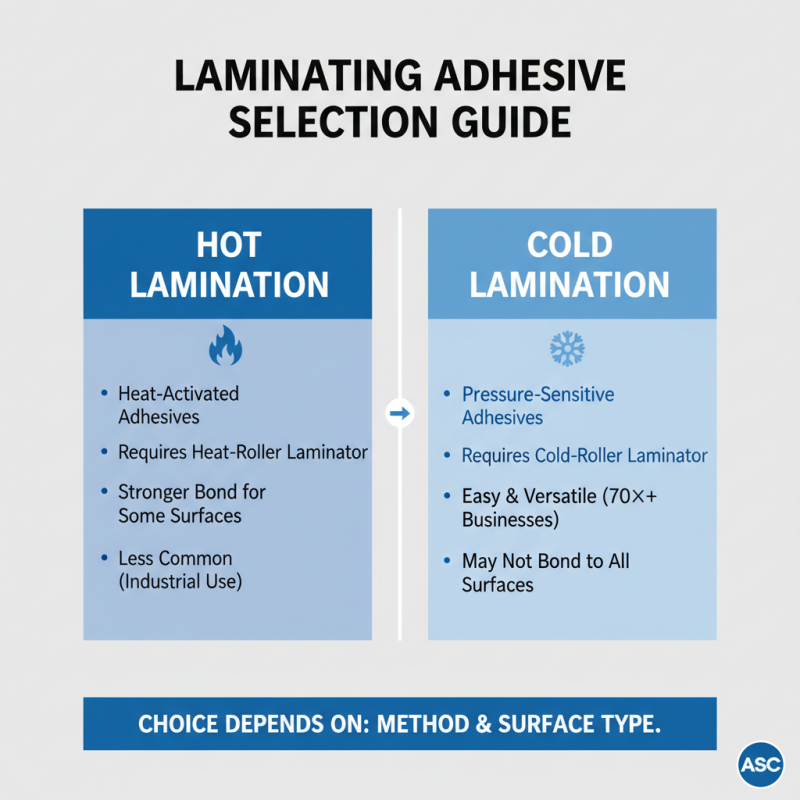
When choosing a laminating adhesive, the application method is crucial. Consider whether you will use hot or cold laminators. Hot laminators require heat-activated adhesives. Cold laminators use pressure-sensitive adhesives. According to the Adhesive and Sealant Council, over 70% of businesses prefer pressure-sensitive adhesives for ease and versatility. However, they may not bond as well to certain surfaces.
The equipment you have also matters greatly. High-end laminators can handle a range of adhesives. In contrast, basic models may limit your options. A report from Freedonia Group suggests that adhesive market growth is driven by technological advancements and diverse application methods. It's vital to ensure that your adhesive matches your equipment's capabilities. Misalignment here often results in poor adhesion or product failure.
Monitor the compatibility of your chosen adhesive with the materials you are laminating. Some adhesives may work poorly on textured or porous surfaces. As noted in a study by the National Adhesive Manufacturers Association, mismatched adhesives lead to a 15% increase in rework costs. Reflecting on your options before committing can save time and money in the long run.
Checking for Adhesive Performance and Durability
When selecting a laminating adhesive, evaluating its performance and durability is crucial. The adhesive should provide a strong bond, ensuring that the laminated items withstand daily use. Look for information on the adhesive's temperature resistance. It should perform well in various environments. Consider how it reacts to moisture, as excessive humidity could weaken the bond.
Test samples before making a commitment. Apply the adhesive on different materials to see how it holds up. Pay attention to drying times. A quick-drying adhesive might seem beneficial but can cause bubbles or uneven surfaces. Always check the cure time; you want it to be manageable.
Remember, not all adhesives behave the same under stress. Observe how they react to physical handling. Some adhesives might seem ideal at first but lose strength over time. Durability is key for longevity. Lastly, read customer reviews carefully. Some problems may not be apparent until they arise. Seek feedback on real-world applications.